The Words of the Week - Jul 24
Dictionary lookups from soccer, law, and the Odyssey
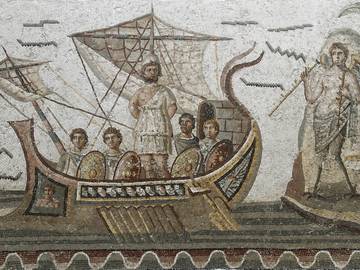
A new film adaptation of the Odyssey opened last Friday, and our entry for Odysseus became a top lookup over the weekend.
Although Homer’s tale was not inspired by a real Odysseus, historians say, it did immortalize a vanished era of gritty Bronze Age chieftains who raided overseas, ruled enormous stone citadels and controlled wide trade networks from 1700 to 1050 B.C.
—Franz Lidz, The New York Times, 15 July 2026
Shall we speak to you of this complicated man? Our entry for Odysseus describes him as “a king of Ithaca and Greek leader in the Trojan War who after the war wanders 10 years before reaching home.” Odysseus is the hero of Homer’s epic poem the Odyssey and one of the most frequently portrayed figures in Western literature. The etymology of Odysseus is unknown, but in the poem itself it is linked to the verb odussomai. As Emily Wilson notes in the introduction to her 2017 translation:
Autolycus gave the baby Odysseus his name, based on the fact that he himself has managed to make so many enemies: “I am / disliked by many, all across the world, and I dislike them back.” The verb odussomai, meaning “to be angry at,” “to dislike,” or “to hate,” sounds similar to Odysseus. … The etymology suggests that Odysseus is himself much disliked, by both gods and other human beings and also that he takes after his grandfather by acting in hostile fashion to other people …
—
The arrest and requested extradition of two influencers led to a rise in lookups for the verb extradite.
Controversial “hypermasculine” influencers and former professional kick boxers Andrew and Tristan Tate were arrested by federal officials in Southern Florida yesterday according to the United Kingdom’s Crown Prosecution Service. Prosecutors in the UK are seeking to extradite the brothers to face multiple charges of rape and human trafficking.
—
The verb extradite can be used to mean “to deliver up to extradition” or “to obtain the extradition of” where extradition refers to “the surrender of an alleged criminal usually under the provisions of a treaty or statute by one authority (such as a state) to another having jurisdiction to try the charge.” Both verb and noun are ultimately Latin in origin: their source is tradition-, traditio, meaning “the act of handing over.” (The word tradition, though centuries older, has the same source; consider a tradition as something handed over from one generation to the next.)
Plumes of wildfire smoke from Canada and the upper Midwest have led to a rise in lookups for haze.
The sky was smoky the day I wrote this column, although it’s often hazy early in the morning in the valley where I live. But this haze was from Canadian wildfires and as the day progressed it didn’t go away like normal morning haze always does.
—
We define the relevant sense of haze as “fine dust, smoke, or light vapor causing lack of transparency of the air.” The noun is likely a back-formation of hazy, whose origin is unknown.
The World Cup yielded one final top lookup this week: nil.
Celebrations have been ringing out across Spain all night after the country’s 1-nil World Cup victory over Argentina.
—
We define the noun nil as a synonym of nothing and zero. It comes from the Latin nil, meaning “nothing,” which in turn is a contraction of nihil. Nihil comes from the Old Latin nihilum, from ne- (“not”) + hilum (“trifle”). Winning the World Cup (by any score) is no trifle, either.
Increased lookups for Rickroll pushed the word into our Top Lookups chart on Wednesday morning. The lookups were not due to its use in a prominent news story, but rather to Merriam-Webster’s Word of the Day entry for July 22, stalwart, which Rickrolled readers in a way, and contained a link to the word’s entry.
… a stalwart lover is one who, through thick and thin, is never gonna give you up, never gonna let you down, never gonna run around and hurt you.
—
We define the verb Rickroll thusly: “to trick (someone) into hearing the song ‘Never Gonna Give You Up’ by English singer Rick Astley." The word was first used with this meaning in the late 2000s (it can also be used as a noun) and was added to our dictionary this year. For a deeper dive into the word’s usage, check out this article.
If someone says you’ve got spizzerinctum, there’s no need to be alarmed. It’s neither a warning nor an insult, but a compliment. Our Unabridged dictionary defines spizzerinctum as “the will to succeed,” and a synonym of vim, energy, and ambition. The word comes from spizarinctum, a dialectical word meaning “cash” or “specie” (money in coin), which in turn is probably an irregular formation of the word specie itself.
He was in a feisty humor that afternoon, full of pep and spizzerinctum …
—