The Words of the Week - Jun 26
Dictionary lookups from the World Cup, Father’s Day, and Washington D.C.
Ken Cedeno/AFP via Getty Images
Father was a top lookup on Sunday, which was Father’s Day.
Miles Russell had quite a Father’s Day gift for his dad: the chance to be the caddie in his son’s U.S. Open debut. The 17-year-old amateur surprised his father, Joe, on the 18th hole Sunday when his caddie brought Russell's clubs to him outside the ropes to carry them the rest of the way.
—Brian Mahoney, The Associated Press, 22 June 2026
We define the relevant sense of father as “a male parent.” The word comes from the Old English word fæder (same meaning), which shares an older ancestor with the Latin pater and the Greek patēr. If you’re wondering, dad is younger, first recorded in the early 16th century, and it comes probably from baby talk.
Hat trick has been trending since soccer star (or football star, if you prefer) Lionel Messi scored one in the World Cup.
Messi, 38, scored a hat trick against Algeria in Argentina’s opener, a 3-0 win, to equal Miroslav Klose's record of 16 World Cup goals.
—
Hat trick refers to the scoring of three goals in one game (as of hockey or soccer) by a single player. The term originates not with soccer, or hockey, but with cricket. In cricket, a hat trick is when a bowler gets three consecutive wickets (or outs) in three consecutive balls. They are very rare—so rare, in fact, that back in the mid-1800s this feat entitled the bowler to a prize from his club, and that prize was usually a hat.
The World Cup also drove lookups for haggis thanks to a prank pulled by Massachusetts governor Maura Healey. (Massachusetts had been playing host to the Scottish World Cup soccer team.)
The governor announced an executive order that legalized haggis, Scotland’s national dish composed of sheep’s pluck (heart, liver, and lungs), animal fat, oats, onions, and spices. … Had it been real, the decree would have made Massachusetts the first state to legalize the food. Since 1971, haggis has been considered illegal in the United States for containing sheep lung …
—
Haggis is a traditionally Scottish dish that consists of the heart, liver, and lungs of a sheep or a calf minced with suet, onions, oatmeal, and seasonings and boiled in the stomach of the animal. Although haggis is always offal, many people deem it quite good. The word haggis comes from the Middle English hagese. Its origins before that aren’t certain. One possibility is that it is related to a word meaning “to chop,” although it could also be connected in some way with rare and obsolete words for the bird otherwise known as the magpie (Pica pica), due to similarities between the appearances of the dish and the bird.
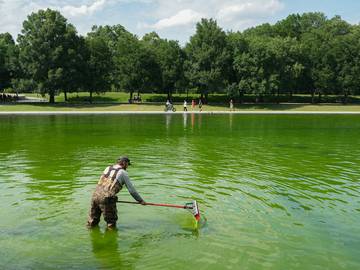
The word alga, plural algae, has been having a big week for lookups as algae themselves have been having a big week in the reflecting pool at the Lincoln Memorial in Washington, D.C.
On Saturday morning, several visitors at the landmark took photos and videos of the pool, focusing in on the algae, while others loudly expressed their frustrations with the state of the pool. On the algae at the bottom of the pool were a few tracings, including a smiley face. Meanwhile, federal employees worked on clean-up efforts, vacuuming the algae.
—
Alga refers to any of a diverse group of chiefly photosynthetic and aquatic plantlike organisms that range from unicellular to large multicellular forms. While multicellular algae often resemble plants, they lack the true roots, leaves, and stems characteristic of vascular plants. Alga comes from alga, the Latin word for seaweed.
Kakistocracy soared to the top of the Lookups chart following its linked use in an article.
... noted how the revelation made clear that the federal government had transformed into a full “kakistocracy.”
—
We define kakistocracy in our Unabridged dictionary as “government by the worst people.” It comes from a combination of the Greek kakistos (the superlative of kakos, meaning “bad”) and the English suffix -cracy, used for words referring to forms of government, or states having such forms. The earliest known use of kakistocracy comes from the early 19th century.
You might be thinking, “but I already know what a pie-counter is, it’s where I set my delicious pies!” Oh ho ho, not so fast, our good pâtissier: this pie-counter refers to a political patronage or spoils especially when regarded as venal or corrupt. The word is included in one of our Great Big Lists of Beautiful and Useless Words, although as the list points out, this word, regrettably, often tends to in fact be useful.
The Post Office has at last been put under civil service protection after generations as the chief political pie-counter. The process was extended to other agencies.
—


