The Words of the Week - Mar. 13
Dictionary lookups from war, weather, and waterways
The verb devastate and related adjectives devastated and devastating were all top lookups this week.
Iran could devastate Qatar’s gas facilities, infrastructure supplying 20 per cent of the world’s liquefied natural gas.
—Yoni Bashan, The Australian, 10 Mar. 2026
This was probably the most devastating event of the war so far—a strike at a school in Minab in southern Iran, said to have killed more than 150, many of them children.
—In addition to the Iranian dead, seven American service members have been killed since the war began, ranging in age from their early 20s to early 50s. Many are parents whose children will grow up without a mother or father. All are mourned by devastated family and friends.
—
We define multiple senses of each of these words. Devastate can mean “to bring to ruin or desolation by violent action” or “to reduce to chaos, disorder, or helplessness”; devastating can describe something that causes great damage or harm or that causes extreme emotional pain; and devastated describes something brought to a state of ruin or destruction, or someone emotionally shattered or distraught. All of these words come from the Latin word vastus, “devoid of habitation, desolate, dreary,” which is also the ultimate origin of the English word waste.
President Trump’s widely reported use of the word excursion to describe the war in Iran led to that word becoming a top lookup for the week.
The president has been referring to his war as an “excursion” in multiple public appearances since the weekend.
—President Donald Trump said on Monday that the military operation against Iran “was just an excursion into something that had to be done.”
—
The noun excursion comes from the Latin verb excurrere (“to run out” or “to extend”). It can be used as a synonym of expedition to mean “a going out or forth,” and can also be used to refer to a usually brief pleasure trip. It can also mean, often with the word into, “deviation from a direct, definite, or proper course.”
The word strait has been much in the news this week, specifically as used in the place name “Strait of Hormuz.”
The U.S.-Israel war against Iran has already effectively halted shipments through the Strait of Hormuz, along Iran’s coast, where a fifth of global oil and liquefied natural gas normally passes.
—
We define the relevant sense of strait as “a comparatively narrow passageway connecting two large bodies of water.” It can also be used to refer to an isthmus (a narrow strip of land connecting two larger land areas) or figuratively (and often in plural) for a situation of perplexity or distress, as in “dire straits.”
Embargo was among the top lookups of the week, possibly in connection with the U.S.’s embargo on Cuba.
Ultimately, the current oil blockade is an intensification of a U.S. embargo that has sought to suffocate the Cuban economy for decades. U.S. sanctions—and in particular the maximum-pressure variety imposed during Trump’s first presidency and largely maintained under the Biden administration—have restricted the Cuban state’s access to foreign currency and credit, led to chronic shortages and price hikes, hampered access to water and transportation, and degraded a health system that was, until recently, one of Latin America’s best.
—
English speakers got embargo—both the word and the concept, it seems—from the Spanish in the early 17th century. The word first referred specifically to a government order prohibiting commercial ships from entering or leaving that country’s ports. (The Spanish word comes from embargar, “to bar.”) By the middle of the 17th century embargo was being used more broadly to refer to any government order that limits trade in some way.
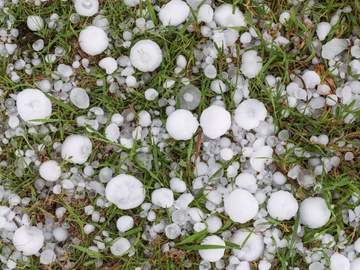
Turbulent weather across much of the country this week led to a rise in lookups for hail.
A massive hailstorm, which accompanied at least one confirmed tornado, struck much of Kankakee County early Tuesday evening. As of late Tuesday night, public safety leadership reported only a handful of injuries related to people being hit by softball-size hail.
—
We define the relevant sense of hail as “precipitation in the form of small balls or lumps usually consisting of concentric layers of clear ice and compact snow.” Hail didn’t just fall from the sky—it traces all the way back to the Old English hægl, with the same meaning. This hail is distinct from the hail used in greeting/saluting/calling/summoning, as in “hail a taxi,” which comes ultimately from the Old Norse word heill, meaning “healthy.” (Hale, as in “hale and hearty,” shares this root.)
Our Unabridged dictionary defines the adjective donsie as a word used chiefly in northern Midland (see sense 2b) dialects to mean “slightly ill.” It sometimes appears with the variant spelling dauncy (both forms are rarely encountered these days). Donsie/dauncy can be traced to the Scottish Gaelic word donas, meaning “evil.”
“You feeling dauncy, Mr. Birdwell? Did you maybe stand up too fast?”
—