Why do we call it a 'flea market'?
Did they ever sell fleas?
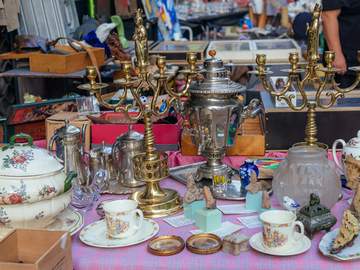
Many people find pleasure in shopping at, or simply browsing in, flea markets. They seem to be not at all put off by the name, even though few would welcome the titular pest into their homes. Where did the term flea market come from, and does it have anything to do with real fleas?
The origin of flea market is somewhat of a mystery, although the etymology likely traces back to the French marché aux puces (literally “market of fleas”). How did a market of secondhand treasures earn such an unseemly name? One theory points to a bargain hunter who declared Saint-Ouen market, the largest outdoor bazaar in 1880s Paris, “le marché aux puces.” The market, lined with stalls of upholstered furniture and pre-owned clothing, seemed a natural place for nuisance insects to take up residency, and the eccentric moniker stuck.
There is some evidence that casts doubt on this theory: there are newspaper articles from the 1880s in the US, referring to this same type of flea market (one that sells second-hand clothes, crockery, and the like), but this one was in Copenhagen, not Paris.
Yesterday was the last day of the flea market. The fifty-two old women who have sat haggling over their uncanny wares in the square by the Government pawn shop until the queer band had become a part of the familiar physiognomy of the city, had been told that their time was up at 8 P.M. sharp, and that the flea market would then be a thing of the past.
— New York Herald, 29 May 1887
A second theory points to mid-19th-century street renovations in Paris. As boulevards were widened, displaced shop owners lost their storefronts and were forced to “flee” to outdoor market stalls. This theory contends that the markets were initially called flee markets in English, and the spelling morphed into flea. It should be noted that there is considerably more evidence for flea than flee.
In any case, by the time secondhand markets became mainstream in the U.S. in the 1960s, the name flea market had lost much of its negative connotation. Today no one seems to bat an eye while purchasing antiques from a market that is probably named after a bloodsucking insect, a testament to the evolution of language (and love for a good bargain).