Why do we say 'fly off the handle'?
Yes, it involves axes
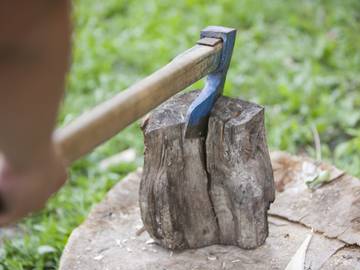
To fly off the handle is to lose control of one's emotions, or to become very angry; it describes going from calm to furious with a speed that catches everyone in the room off guard. It's the kind of phrase that neatly captures a specific thing: something controlled becoming dangerously uncontrolled in an instant. But where does it come from? The answer, it turns out, involves axes.
Before fly off the handle meant anything about anger, it described a genuine occupational hazard of 18th or 19th century frontier life. When an axe head was poorly fitted to its handle, or when the wood had dried and shrunk, a hard swing could send the metal head flying free of the handle entirely. For anyone in the vicinity of a lumberjack with a loose axe, this was not a theoretical concern. A spinning blade of iron departing at speed in an unpredictable direction has a way of focusing the mind. The vivid danger of that image made it natural material for metaphor. A person who "flies off the handle" behaves much like that axe head: suddenly detached from whatever was keeping them steady, and hurtling forward with alarming and uncontrolled force.
The figurative use of fly off the handle began to appear in print in American English by the 1830s. In early written cases it often is used to imitate spoken, or vernacular, language.
But he wouldn’t believe me till he took his glasses and red it himsely, and when he see it was all just as I red it, I did’nt know but he would a flew off the handle. I rally believe if he had been in Nashville then, he would have gone right into the Legislature and drove every son-of-a-gun of ‘em out of the State House.
—The Record (West Chester, PA), 25 Nov. 1835
It's worth noting that the phrase carries no implication about why someone loses their temper; only the manner of it. You can fly off the handle over something trivial or something genuinely upsetting. What defines the expression is the suddenness and the loss of composure, not the cause. Nearly two centuries after its first recorded use, fly off the handle remains a perfectly serviceable idiom. It has outlasted the era of axe-wielding woodsmen that gave rise to it, which is perhaps a testament to how well the image works. Most of us will never witness an axe head come loose mid-swing. But we've all seen (or been) someone who suddenly, unexpectedly, and figuratively went flying.