Why do we say 'make a beeline'?
Yes, it does involve bees
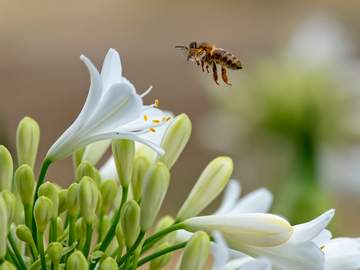
If you've ever made a beeline for the coffee maker first thing in the morning, you've used one of the more zoologically interesting idioms in the English language. The expression means to move quickly and directly toward something, and its origins lie in a genuinely old observation about the behavior of honeybees.
The assumption baked into beeline is that bees, when heading home after a day's foraging, fly in a perfectly straight path, which turns out to be more or less accurate. When a bee departs a flower or is released from captivity, it sets an impressively direct course back to its hive. Watching a single bee buzz around a garden, it might not seem that way; the creature appears to meander, to investigate, to generally do as it pleases. But when it's done and heading home, the bee moves with a kind of purposeful efficiency that naturalists of yore found remarkable enough to name.
Bee-line, spelled with a hyphen, appears in print as early as 1828, when it was used in something close to its scientific sense (in a review of a book about honeybees) to describe the straight-line path a released bee appeared to take toward its hive.
In the Philosophical Transactions of 1721, is given a curious account of the method practised in New-England, for discovering the hive of the wild-bee of the woods. The bee-hunter decoys … some of the bees into his trap, encloses them in a tube, and letting one fly, marks its course, by a pocket compass. Departing to some distance, at right angles to the bee-line just ascertained, he liberates another, observes, its course, and thus determines the position of the hive.
— The American Quarterly Review, 1 June 1828
The use of beeline certainly originated with scientists writing about bees, and our earliest written evidence of this comes in 1828, but the word was probably in use before then. We can assume this based on the fact that bee-line also shows up at about this time in newspapers, used in a decidedly figurative manner, to refer to people, and not bees, moving.
He hacked and drew a bee-line soon afterwards. But perhaps you don’t know what this last sentence means. Indeed! A pretty brace of critics you must be, to talk about Queen Ann’s writing and not know the pure English of your own country! To “hack and draw a bee-line,” then, means to turn round and clear out straight.
— The United States Gazette (Philadelphia, PA), 9 Oct. 1829
The modern spelling, beeline, drops both the hyphen and any remaining naturalistic pretense. No one using the word today pauses to consider honeybee navigation. That, of course, is how the best idioms work: the original observation fades into the background, and what remains is pure meaning; in this case, the sense of moving with determined, unhesitating speed toward a destination. The bee is long gone, and only the line remains.