The Words of the Week - Feb. 27
Dictionary lookups from art, Mexico, and the Blizzard of ‘26
Violence in Mexico has led to a rise in lookups for cartel.
Mexican security forces killed the drug lord, Nemesio Oseguera Cervantes, known as El Mencho, the leader of the Jalisco New Generation Cartel, on Sunday. Almost immediately, Guadalajara, Mexico’s third-largest city and the capital of Jalisco State, was plunged into chaos as the cartel retaliated, with violence spreading to cities and beach resorts across Mexico as gunmen torched stores and banks and blockaded highways.
—Maria Abi-Habib, The New York Times, 23 Feb. 2026
We define the relevant sense of cartel as “a combination of independent commercial or industrial enterprises designed to limit competition or fix prices.” Cartel is ultimately derived from the Greek word for a leaf of papyrus, chartēs, and is thus a relative of card, chart, and charter. In Latin, the Greek word became charta and referred to either the leaf or to that which is written on papyrus (such as a letter or poem). Old Italian took the word as carta and used it to denote a leaf of paper or a card. The diminutive form cartello served to denote a placard or a poster and then acquired the sense of “a written challenge or letter of defiance.” The French borrowed cartello as cartel with the meaning “a letter of defiance,” and English then borrowed the French word in form and meaning.
Lookups for bombogenesis were high in conjunction with a massive winter storm hitting the northeastern U.S.
According to the U.S. National Oceanic and Atmospheric Administration, certain storms undergo bombogenesis, which happens when a storm’s central pressure drops at least 24 millibars in 24 hours. These storms are sometimes called bomb cyclones. Storm intensity is measured by central pressure, so the lower the pressure, the stronger the storm.
—
We define the meteorological term bombogenesis as “rapid intensification of a storm caused by a sudden and significant drop in atmospheric pressure : the development or intensification of a bomb cyclone.” The word was first used in print in the late 1980s.
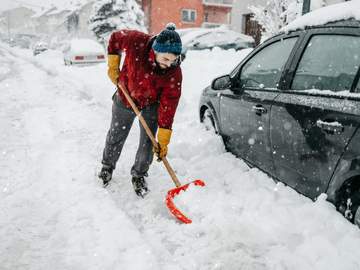
The winter storm, which dumped over 37 inches of snow in parts of Massachusetts and Rhode Island, also drove lookups for blizzard.
The Blizzard of ‘78 was just a touch more intense than Monday’s blizzard because of how much more widespread significant snowfall reached, but ultimately, they both belong in the same discussion as two of the most impactful winter storms the region has ever seen.
—
We define the relevant sense of blizzard as “a long severe snowstorm” but it can also be used to mean “an intensely strong cold wind filled with fine snow” and “an overwhelming rush or deluge,” as in “a blizzard of mail around the holidays.” The earliest recorded appearance of the word blizzard meaning “a severe snowstorm” was in the April 23, 1870 issue of a newspaper published in Estherville, Iowa. However, in other senses, the word blizzard existed earlier. Davy Crockett, for instance, used it twice in the 1830s, once to mean a rifle blast and once to refer to a blast of words. All of these uses seem related, but the ultimate origin of the word is still unclear.
The abduction of Nancy Guthrie, mother of Today show host Savannah Guthrie, has led to a rise in lookups for the word ransom.
An unknown person’s DNA was recovered at the crime scene, authorities said. Meanwhile, reports have indicated the Guthrie family received a ransom demand of millions of dollars to be paid in cryptocurrency.
—
We define the relevant sense of the noun ransom as “a consideration paid or demanded for the release of someone or something from captivity.” The word traces back through the Middle English ransoun to the Anglo-French rançun, and further back to the Latin redemption-, redemptio.
Craquelure refers to a cracking (as of varnish, color, or enamel) on a work of art, making it a prime candidate for Words for Things You Didn’t Know Have Names. But that doesn’t mean you won’t occasionally encounter it in print, used either literally or figuratively. Craquelure is a borrowing from French, and first appeared in English in the early 1900s.
… a pair of plaster lamps with spiral shell-form bases. Designed in the mid Twentieth Century, these lamps had small losses and craquelure, though bidders still took the pair to $12,800, far exceeding the $2,000 high estimate.
—The brown surrounding landscape was a craquelure of dry gulches.
—